Tuesday, June 16, 2026

An imperfect perfection.. my review of the Mandler 35mm f2 " King of Bokeh" clone

The Mandler in it's proper place, on Author's M10M


As you might have inferred from my previous posts about the Leica M system.. I got sucked in by a beautifully made and designed bag, and went on to purchase one of their most expensive bodies.  Not much cash left over for lenses.. and they can be VERY expensive. So I was excited to hear about the Mandler 35mm lens, released late last year but still very hard to get.  All the internet was abuzz.. Even Mr Leica (Matt Osborne) was waxing lyrical about it.. And so I decided, in my very individualistic and non-consumeristic way, that I needed to have one as well.  And after staying up till 3am for when orders for the next batch would open.. I finally managed to buy one!


Just some of the boxes..

And in short order the lens arrived.. And what a beautiful unboxing event it was. There were so many boxes! An outer shipping box. An intermediate lens box. And inside, the actual lens box.. and inside that the clear plastic lens holder a-la-Leica style. And then there were boxes for the filter, the square hood and the metal hood.. It was a long and drawn out experience.  Where am I going to store all these boxes?!

The lens.. was small! And it was light. And it was beautiful.  But it was also Chinese.. so there had to be a problem? Well.. let's not get ahead of ourselves just yet.  The experience of placing it on the camera and taking pictures with it was.. sublime.  This was a lens designed to offer loads of " character".. euphamism for lens defects that.. I really like. Flare? Check.  Vigneting? Check. Sunstars? Check.  Beautiful bokeh balls? Check.  It really did tick all the boxes and then some.  Wonderfully small and compact, it made my M10 almost pocketable. And as I looked at the latest Leica lens releases.. with their Noctilux 35mm f1.2.. and it's massive size, I was happy in the thought that with my M10 Monochrom sensor, I could essentially shoot with this smaller and lighter lens.  My wallet was also extremely happy about this decision, as it was still coming to grips with that I'd ripped out of it to get the M10M.  So far so good.  


Mandler in action, with it's very peculiar flare


But (and here my English teacher is rolling in her grave.. never start a sentence with a But!) one's journey with Leica M is never ending.. and so I gathererd more and more lenses to the stable.. almost none of them actual Leicas. And then in my Lightroom.. I started struggling to know which one I'd shot. And it dawned on me.. my M10M, and M8 that I purchased for a song soon after, could both read 6-bit coded lenses. So.. how to code my "clone" lenses?  Simple.. internet to the rescue. And there I found some bright spark who had designed a marking ring for the Leicas where you could mark the codes. And then another bright spark in China copied that bright sparks idea and sold the ring for less than half price.  The story of the 21st century.


My finger pointing at the offending screw - Voigtlander 35 f1.4 with space for manually applied code next to it

So now I had a marking ring to mark all my lenses.. and here is where I started to see the Mandler wobble a bit.. You see, the guys at Mandler were so busy copying the lens design and elements, that they completely forgot about one of Leica's great modern innovations, which is to let analog lenses talk to digital bodies - the 6-bit code.  If you are new to Leica or shoot exclusively film, this innovation is of no interest, and you are under no obligation to know about it.. But you probably know anyway, because any Leica innovation gets talked about by everyone. And the innovation is to engrave marks in the lens mount, and colour those engraved areas with white and black, and on the camera side what is essentially a bar-code reader scans and identifies the lens.  Not only that, on more modern bodies such as the M10M, the camera is able to apply profiles correcting for basic lens shortcomings, such as distortion, vigneting and (I believe) chromatic aberation.  And.. when you download your pictures and want to know which is your most used lens, the info is there.  Great for the geeks amongst us. I being one of them.  So what's the problem with the Mandler, I hear you ask?  Well, when this 6-bit coding was invented, oh.. when the M8 came out in 2006, most of the Mandler staff were still in swadling cloth.. and so didn't hear about it.  Because... (another roll around your grave Ms whoever you were teaching me english) they put a screw squarely where the 6 bit codes should go..  And considering that this lens was made in 2025/2026.. this is unforgivable..  It also makes this lens a bit less useful than I would have hoped, considering that it's a 1:1 copy of the Leica optic of King of Bokeh fame, and so the optical adjustments would have been perfect for it.  And also because when no lens is present, the camera defaults to a 50mm f2 profile. Which is not the same.  Not by a long (or short) stretch.

The lens hood button squarely where aperture ring indentations are


Next bugbear.. though this may be the same issue on the original Leica lens that it was copied from.. When using a lens hood, which has some groves to slot into the lens in a specific orientation (helpful for the square hood design for example) the springs that hold the lens shade in.. also interfere with you operating the aperture ring.  Now granted, one doesn't buy an f2 lens to shoot it at f16, and I am most assuredly a proponent of shooting lenses wide open. So under normal circumstances the aperture will sit at f2 and stay there for the duration of the shoot. However.. because the lens is so small, when you mount the lens, there is so little to hold onto that you invariably grab the aperture ring to mount the lens, and in the anti-clockwise motion of seating the lens, you invariably shift the aperture to a closed position. And when you start shooting, and are attempting to ensure aperture is wide open.. the hood is now in the way.. Solution.. ditch the hood. Better for flare. :-)

After mounting lens, the aperture landed at f2.8. Not bad.. not great.


Whilst these two flaws are not completely insurmountable - did Cartier Bresson fuss about which lens he used?  No he didn't.. because he only ever shot with a 35mm lens. Or was it 50? Can't remember..  No, the issue is that, once again, we are reminded of why Leica is Leica, and why the copy-cats are copy-cats. 

I'd like to say that though I've talked mostly about the ergonomics of this lens, the images are really quite nice and usable.  The flare at night is as spectacular as it is intrusive, though it might be a look that you may eventually tire of.  I quite like it and can now pick this lens out from the other 35mm lenses I now own (don't ask!).  The sharpness is enough for what I need, the images are pleasant and full of character.  However I've found it's replacement.. a faster lens with even crazier flare and similar form factor. So.. the Mandler will be going on the chopping block. Sorry my Sino-friend.  

Tuesday, April 28, 2026

Leica Part 1.5 or.. How one bag ruined my bank balance - a review of the Billingham for Leica Combination M bag

Firstly, I must excuse myself for this rather back and forth with Leica. Truth be told many articles exist in the galaxy of my brain, doing concurrent revolutions around my sun (or.. living as 1's and 0's in my Macbook).  So at any time I could have three articles about the same subject, written at different times, about different stages in the thought process.. and being written in bits and pieces, more or less concurrently.  If this confuses you, don't worry, so am I. Basically I struggle to finish anything.. I start, good intentions and all, and then get distracted. My wife says I have undiagnosed ADHD.. I'm also left handed. So.. 

Anyway, this long preable just to say that there was supposed to be an earlier article to my Leica Part 2, but so excited was I when I received my Leica M10, that I wrote that piece, and completely hopped over my earlier work. So, this is my attempt to put the threads of time back in their place..

How one bag ruined my bank balance.. or a review of the Billingham for Leica Combination M bag

The innocuous looking bag.. Looks fairly harmless, doesn't it? 

It’s not often that something small has a massive, outsized impact, all way out of proportion with the object itself.  Think of an asteroid.  When it does happen though, you feel it.  But first a word from our sponsors.. No, no, none of that. Just an introduction with whom you’re “speaking”.  I’m a middle aged man who started photographing at 12 with film, and who over the past years has managed to own every camera that he ever dreamed of in his 20’s, when he struggled to afford expired film.  I own more bodies and lenses than my wife does shoes.. and that’s saying something. I’ve bought and sold into camera systems, expanded and contracted my “collection” through bouts of G.A.S. and progressively owned more lenses and taken fewer pictures with them. Sound familiar?   It was therefore inevitable that I would, one day, try a Leica.  And so it was.. I went on a Leica buying spree.. found a decent looking M3 for a(n) expensive song.. and an actual modern Leica lens, the Emarit-M 90mm f2.8.. supposedly the sharpest 90mm leica has made (words of Erwin Puts, author of the authorative Leica Compendium).  I was set for photographic perfection. And then a strange thing happened. I didn’t like it (pun intended).  The rangefinder ethos just didn’t gel with me. And so like a petulant child, I found something else to lust over, and promptly sold my whole M system (at a slight profit I might add!).  However that wasn’t the end of the affair with Leica itself, as I realised that it wasn’t the brand or the quality I had an issue with. Indeed, the M3 was like a jewel, a mechanical watch with Rolex levels of quality. It was amazingly well built. And the only other camera up to then that could compare to it was the Hasselblad 500c/m (which I also bought during a sleep deprived late night Ebay binge session).  So I then did the next best thing and started buying Leica R lenses and bodies.. and when I had enough I sold off the surplus bits (who needs 4 Leica R bodies?!) and kept the cream.

And then another thing happened.  I needed a nice bag to hold my jewellry.. I mean cameras! And after iterating through the usual American suspects (Lowepro, Temba, Peak Design, ThinkTank) I gravitated to Billingham.  Think of it as if you went from American fast food to a Michelin starred restaurant.  The American stuff just never quite filled you up, no matter how often you went back for more.. The Billinghams were the real deal though. Built to last, unlike the American crap that had sealed seams separate, plastic delaminate and metal bits rust.  No brand (except maybe Temba) survived my rigorous tests..  And so I started getting Billingham bags for different occasions and camera systems.  If you’re a photographer then you know.. you need several bags. One that will take your medium format system. Another for casual walking around. And then, you’ve gone mirrorless, right? Well then, another smaller bag for your mirrorless setup. Minimum 3. Probably many more.

So where am I going with this long-winded introduction into my rather uninteresting personal photographic journey?

Well, after tasting the Billingham style, I happened upon an unusual bag with Leica blazoned on it, but made by Billingham. A black one. Unusual because the Billingham dna is khaki with brown leather and brass.  This bag was different. Simpler. Black with chrome snaps and zips. And an intriguing little label inside that said Billingham for Leica. Such are the wanderings of Facebook Marketplace that you find these hidden gems. And so I researched the bag, and found out that it had been created to hold an M system (whereby the Combination M part of the bag name).  And so intrigued by the bag, I was, that I quickly arranged to buy it.  It arrived.. and contrary to my other Billingham bags I already owned (remember something about at least 3 bags...) this one exhuded.. style. But more than that, it had a simplicity of purpose, that my other Billinghams simply didn't.  There was no fuss with this bag.  It had been stripped down to the essentials, but it's strap went all the way around the bottom of the bag. Quality too. Fewer pockets and zippers than a standard Billingham.. It was perfect. Except.. my Nikon Z8 mirrorless camera wouldn't fit! Imagine that, I had a bag, and couldn't fit my camera.. So what do I do? Sell the bag, right? No... Get a new camera! 

The original text was in white on black background, but in my effort to "stealthify" the bag, I coloured in the text with a black marker. Still Billingham for Leica, just more discrete  

And so started my odyssey in searching for a Leica M.. Many hours of research.. many hours poring over the auction sites.. and many hours making lists of features that I needed, and things that I didn't need, or didn't want. And slowly the choice began to coalesce.  The M3 had not worked.. because it was film, and I needed instant gratification.. ahem.. immediate feedback on my out of focus shots.. So digital it would have to be. And then.. an external viewfinder was going to be necessary, because I like using wide angle lenses.. So out went the M8 and M9.. Then.. I thought long and hard about what output I wanted.. And then I remembered my recent trip to italy, where I had used my iPhone exclusively (no space for a mirrorless camera with big lenses), and then converted all my pics to black and white.. So..a monochrome camera (in Leicaspeak, we drop the E at the end). Ok, a monochrom camera.. And so it was, that my Billingham bag precipitated my biggest purchase of the last few years.. 

The slippery slope of owning a Billingham bag leads you down to.. this piece of expensive jewellery


Moral of the story. Use Lowepro!  


Monday, April 20, 2026

Leica - Part 2

When you repeat an action, but expect another result it.. I believe, is the definition of insanity. And if that is anything to go by, then I am insane. Because, yes, you guessed it, I've bought another Leica M.  After my last post, almost a year ago, where I explained in excruciating detail, why I couldn't make the Leica M system work for me.. I've gone and purchased another. However.. I might have cheated a little. And when I say a little.. I mean a lot. 

I mean.. insanity means you can do what you want.. think what you want. and change your mind when it suits you.

And so I purchased a Leica M10 Monochrom. Which.. had been sitting in the back of my mind ever since I heard of Leica's first Monochrom camera back in 2011 with the M9M.  So why is it a cheat?  Well, first off, it's digital, which means that the long wait between badly exposed photography and getting the pictures back from the lab went down from several months (the average time a roll lives in one of my film cameras) down to.. instant. And secondly.. because unlike a Leica M film camera.. with an M10 I can actually use a digital viewfinder and see through the lens. And that changes EVERYTHING.  The whole M equation is completely flipped, upended, rendered moot.  Now.. I can see what I'm doing, and I can get what I want out of the camera (a black and white image) right out of the camera.  This is truly.. amazing. Ok, let me be very clear. This is AMAZING! 

Why? 

Because my love of photography started with black and white images developed in the school darkroom in Sydney in 1982.  And all through my journey through different camera models and film stocks, mostly Tri-X and then Ilford XP (that's how long I've been shooting.. when it was just XP, not XP2!), then digicams, then DSLRs, then mirrorless digital.. I was always searching for the perfect black and white image.  Of course I also shot colour, and enjoyed colour. But it wasn't what I wanted. And I spent endless hours toggling images between colour and black and white, to see which worked and which didn't. And that's time of my life that I'll never get back.  Now however, from the get-go, I have my image in black and white. And with an M10, it's a better image than I've ever been able to achieve with a bayer filter camera (basically all digital's out there)..  Not only is the quality amazingly detailed with it's 40mp sensor, but my camera can see in the dark at ISO 100,000.  Sure, it maxes out at that number, the same as my Nikon Z8 in Hi 2, but at that ISO, the M10 images just look like film with a bit of grain.. Absolutely usable images. Whereas my Z8 is simply garbage.  I now shoot at night.. walking around.. with my M10. Simply outlandish! 

Not only that, but with 3 buttons on the back of the camera, and with a menu written for a child, it is possibly the simplest digital camera I've ever owned.  The Rolex feel of the buttons is not quite there, to the level it was with the M3.. but the M3 was Leica's masterpiece. However the M10M feels sculped from a block of brass, all hard edges and corners in a way that they just don't make cameras anymore.  

As for lenses.. well, remember that 90mm f2.8 Elmarit-M that I said I didn't use much? Well.. I found another.. a South African photographer who's downsizing.. we had a meeting of minds and an exchange of cash, and now I have my least used lens again :-)  Though I may not use it often.. it is a beautiful lens to work with, and with my high ISO, I can use it with impunity. 

Second Leica lens is quite an unusual one, the 50mm summicron Dual Range (DR for short) which focuses down the the rather useful 40cm.. much closer than the standard 0.7m of newer Leica lenses, which makes it an excellent close quarter portrait lens or semi-macro (nothing with Leica M's is ever truly macro).. Possibly the heaviest densest lens I've ever owned.. it is a joy to use in the same way the M3 was a joy. Mechanical perfection. 

More to say about this development in the weeks to come, but understand this, I haven't felt this excited about photography in quite a while. And it's not about holding a beautifully made object, it's about the images that I'm creating now.. 


Saturday, April 12, 2025

Leica.. or photographic madness

A few years back (or more preciceliy, in 2018) I more or less forced myself to love Leica.  I found an M3 rangefinder in a niche serial number range with most of the later upgrades but with the more aesthetically pleasing buddha ears.. 


Confused?!  Well then, you, dear reader, are not a LEICA PERSON! I admit, I went full bore with my obsession, watching every online video I could find, and eventually purchasing the seminal work of Erwin Puts (1944-2021) called the Leica Compendium, a more or less complete catalogue of all their film cameras and lenses.  


I purchased the book directly from the man, so just a few years before his passing.  I pored over MTF charts, read his lens reviews, before settling on just ONE Leica lens, the 90mm f2.8 M. An absolute work of art, an engineering marvel.. and a lens I hardly used.  To this I added a more functional Canon "Sumilux".. a 50mm f1.4 LTM lens (for those few readers who are not a LEICA PERSON.. it means Leica Thread Mount) which saw marginally more action.. but far too little to justify the expense. 

Leica M3 with Canon "Summilux", with buddha ears hidden behind a leather strap

You see, though I might have considered myself a LEICA PERSON.. I was definitely NOT a rangefinder person.  I knew this of course, when I was given my father's Canon 7 with the absolutely magnificent 50mm f0.95 lens.. which after a few rolls ended up sitting in the cupboard (it's still there, after all these years).  So why persist with the rangefinder madness?  Perhaps my problem was that I had used an inferior Canon rangefinder, and the Leica was the ticket. And the Leica M3 WAS superior in almost every way to the Canon. The weight of a gold ingot, machined to Rolex levels of mechanical perfection (or maybe it's the other way around.. Rolexes are machined like Leicas..). It was truly a work of art, and a fabulous machine, and one that I simply could not use.. In the end I sold it for a modest profit, but I did not miss it. I mean.. it's not like I could wear it on my wrist!

However.. the love affair with Leica HAD been kindled, and so I decided to try out their SLR line, being more in tune with my personal preference. My first serious camera had been an SLR, the Yashica FX2000 followed some years later by the Pentax K1000.. the most basic camera you could hope to find.  So off I went to Ebay in search of some Leicas to play with.. and found myself with three. Just sounds like a good number I guess. First up was the R4, followed closely by an R7, last of the "traditional" SLR Leicas.. and rounded out by the Hunchback of Solms, the R8.  I fell for the R8 after trying out a friend's camera, as even though it was chunky and heavy, it has hewn from a solid block of metal, and evoked the spirit of the M3 with it's watch-like precision, that the R3 to R7 line simply did not, with plastic dials and bubbling top plates.  Then came the lenses, bought and sold in feverish fashion, as I tried to find optical perfection (with an eye to budget).. I mean optical perfection would have set me back several tens of thousands of dollars, so I had to tread carefully.  True, R lenses are generally cheaper than analogous M lenses, but ever since film-makers discovered they could adapt these Leicas to cinema cameras, prices have been going up.  I bought and (stupidly) sold a 50mm f2 

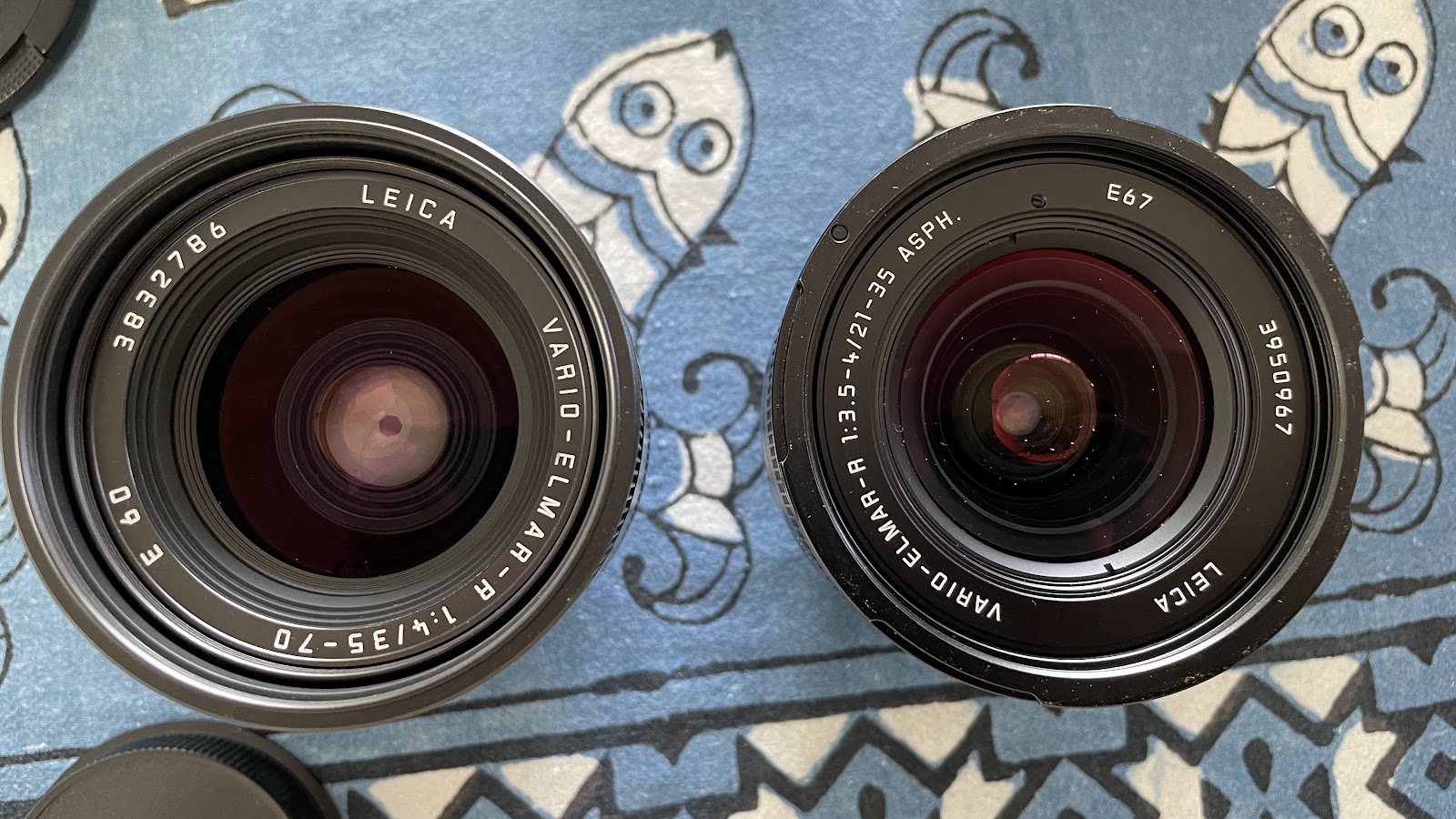
Summicron, thinking the f2 was too slow, and then just as quickly bought and sold a 50mm f1.4 Summilux.. which was absolutely dreadful wide open. I mean, why would one buy a fast lens and then shoot stopped down to f8.  And then I bought another Summicron, which in my experience is the sharpest with the most pleasant bokeh of any of the 40 odd 50mm lenses that I've used in my life. Even better than my Canon 0.95 dream lens (you remember, the one that's still in the cupboard?).  I tried some late zooms from Leica, the rather astounding 21-35 f3.5 and 34-70 f4 and both were beautifully built, with ranges that were quite useful.. but the relative slow speed and resultant dark viewfinder meant they were not my favourites, and were soon moved on. 

Two stunning zoom lenses of Leica design (earlier ones were Minolta derivatives)


But in the sine-wave that is our life's journey, my period of expansion into the Leica R world was followed by a period of contraction.  Gone now is the R7, fun as it was to use. 

Possibly the most comfortable R to hold, because of the extra bit at the bottom

Gone is the R8.. 


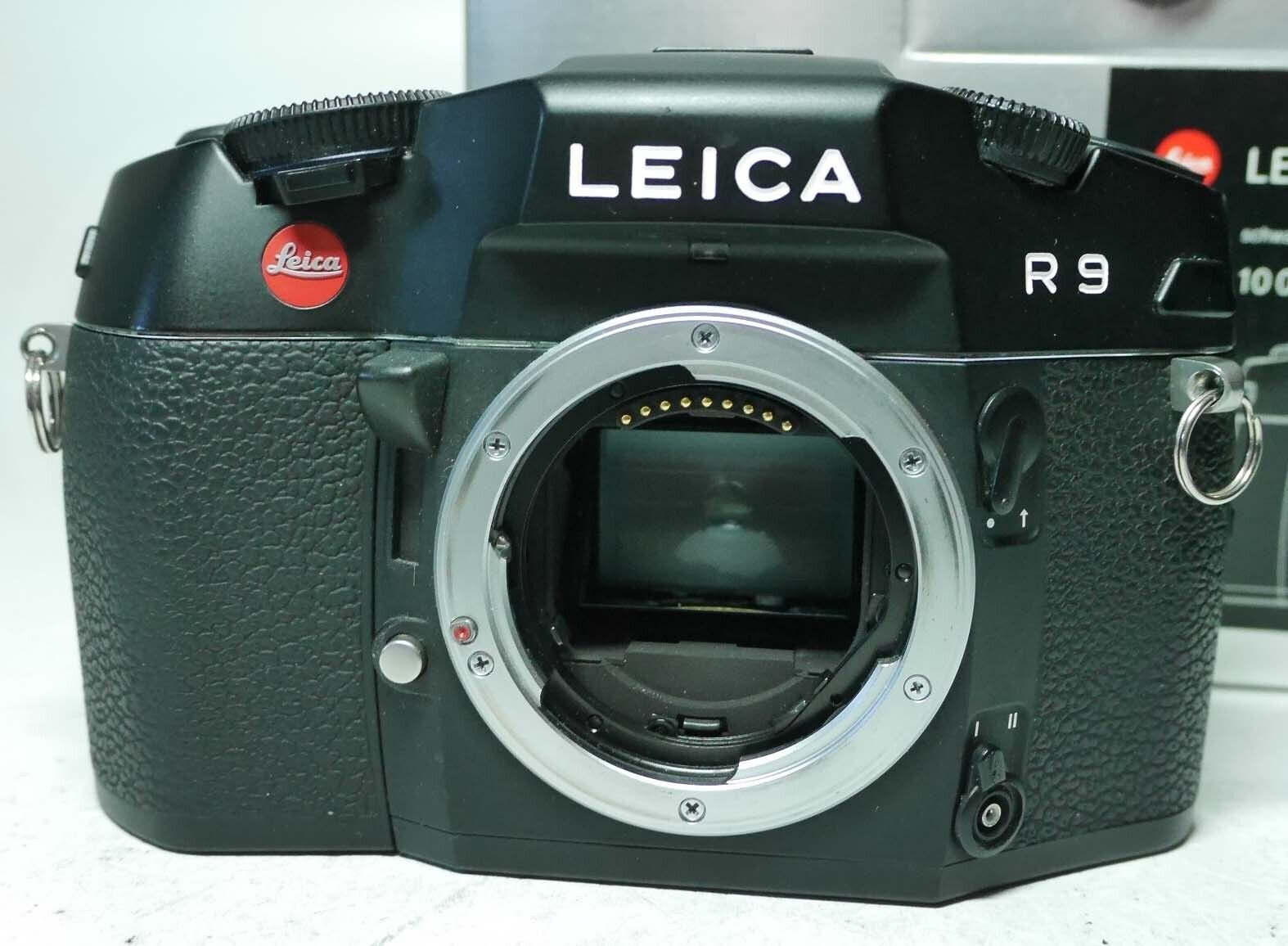
which I regretted as soon as I'd sold it.. But in my mind.. I had a plan.. to own the best that was ever produced, of anything. And what's better than an R8?! Well, an R9 of course!  Released in 2002, 6 years after the R8... I must say, in 6 years they didn't make any major changes! BUT... it is the very last film slr from Leica, and the refinements are quite nice. Lighter, focus and recompose actually works (my R8 would reset the meter when you recomposed.. defeating the objective...pun intended). And it's rather chunky design is actually quite pleasant to hold.  A lock on the mode dial, which I was constantly moving by accident on my R8, and a nice little frame counter on the top plate. Small things. But they perfected the already pleasant design of the R8. In black of course..


As for lenses, I've settled on a trifecta. A 35mm Sumicron, which a LEICA PERSON knows is an f2 lens.  Then my 50mm Sumicron.. which is simply stunning. And finally an absolutely dense lens, the 80mm summilux f1.4.. a singular portrait lens!  These would by my only lenses.. a perfect numbers. Oh, but wait.. I haven't mentioned my other camera.. the one I didn't sell?  Leica's last fully mechanical SLR, the R6.2. In absolutely perfect condition. But if I'm honest.. I shoot with the R9 more often. The second body is just so I can swap between colour and black and white. Or when I want to be a bit more discrete, as it's profile is about half that of the R9! 

Will this be the end of the story?!  Or will I be tempted by yet more bodies and lenses? If (my) history is anything to go by, if GAS principles hold true, and if the perfect number of anything to own is N+1, with N being the current number owned... then yes, I will most likely indulge in a lens here or there.. My penchant for landscapes means I will eventually need a wider lens. And I quite enjoyed the 135mm focal range in the past, so having another (lighter) portrait lens may be welcome. However those are only desires.. my needs are most assuredly already met by what I have! 

Saturday, September 23, 2023

Why I sold the Z7ii.. or how relaxed and learned to love film.. again

Yes.. I've sold my Z7ii.  I know, this may not come as a surprise to you all, considering my last post.. but I have to admit I am more than saddend by it's departure.  I... miss it!  I know I've harped on about all the Z7ii's failings and short-comings, whilst tempering my excitement for it's positives.. It's a dainty camera built to D750 levels with a D850 sensor.. It's mirrorless, and that's new so it's great. What was even greater, and perhaps rather unsung, was it's ability to take lenses from other marques and.. autofocus them.. in may cases better than on the original cameras. And with the focus zoom function, you can really nail focus on the eye. So out I went and purchased every single Canon L lens I'd ever wanted.. and away I went.  By most indications I did shoot quite a bit with it.. A total of 10,000 shots. In 23 months, so just under 2 years.  That may not seem like a lot, but I'm not a big shooter, and though more recently I'm doing more sports shooting, I prefer portraits and landscapes, where spraying and praying is not really required.  Only one other camera averaged the same volume in my stable, and that was the D810.  So notwithstanding all the shortcomings I alluded to in my previous post, this, in fact, was quite a successful camera for me.  Maybe the lack of bulk and weight made me want to take it along more often? Maybe the added joy of using different lenses from different makers made me want to experiement more with it?  Who knows.  I simply have to conclude that it was a great little camera, and more than suited to my requirements.  Who knows.. I may hunt for a used one as a back-up camera :-)

Tuesday, March 29, 2022

Why I don't like the Nikon Z7ii


I have been an avid photographer (subtext - amateur) with some forays into professionalism (event photography, product photography) for the better part of 39 years. Wow.. Thats a long time.  I've managed to transition from manual focus to autofocus, and then from film to digital slr's, and now the latest transition, from DSLR's to Mirrorless.  While waiting for Nikon to get it's act together, I experimented with the Sony A7RIII full frame Mirrorless camera, and then just as promptly dumped it, as it wasn't for me.  The philospohy of the two camera makers couldn't be any more different, and my acquired muscle memory of Nikon controls meant that I was constantly fighting with a camera that would simply not co-operate. Plus the colours looked terrible.

Nikon then did the inevitable and caught up with everyone else and released their Z6/Z7 duo, and I was invited by Nikon to one of their launch events in Australia.  I was mightily impressed, although like many I was also perplexed at the glaring omissions to the camera's functionality, like dual card slots.  I voiced my concerns with Nikon, and strangely for once, they seem to have listened, and barely 2 years later released an update, the Z6ii/Z7ii duo.  Or maybe they listened to the tens of thousands of other photographers clamouring for the same things.. I can't be sure. 
Aaaanyway, in the mean time I'd sold off the Sony, and was back to using my Nikon D3s, and really felt the need for a higher megapixel camera capable of using all my plethora of lenses from various mounts.  I finally took the plunge (again!) into mirrorless and bought a Nikon Z7ii.  The camera felt reassuringly similar, yet also strangely different, and this was immediately apparent when I tried to control the camera.  Pro level controls were not present - more "prosumer" controls á la D600 or D750 were in their place.  Strange omissions still continued, like the two-button format option present on just about every Nikon DSLR since time immemorial.. Gone..  I discovered much to my dislike, that they had removed the manual DX lens selection option.  And the final cherry on the cake (not!) was the fact that they'd removed the Picture control option for scanning negatives.  

Now don't get me wrong.. I undestand all about marketing tiers and creating levels of products for customers to oogle at.  That's all fine.  And as Mirrorless stands today, it is clearly positioned by Nikon to be inferior to their pro DSLR offerings (D6, D850 and D500).  Those cameras have a totally different design philosophy and their differentiated controls echo that.  However right now the Nikon Z7ii is MORE expensive than the "equivalent" D850, with which it shares an important attribute, the sensor.  So different controls, different viewfinder, but same image quality, and comparable in price, though with a clear pecking order.  The "cheaper" camera.. is the better camera.  Yes, I know, the D850 is near the end of it's life and hence price is lower, and the Z7ii is at the beginning of it's 2 year product life.  The two cameras have very different Autofocus capabilities, with one sharing the AF of the flagship D6 and the other a newer though (currently) less capable AF technology, Mirrorless.  Nikon WANT you to buy into Mirrorless, however it is still not as good as DSLR in that important category.  Instead of sweetening the deal though, they have arbitrarily taken out features much the same way Canon or Sony have done for centuries.  Well, ok, years..  Once upon a time this would have been anathema for the more engineering oriented Nikon...  Well, I guess we all have to grow up and stop playing with our meccano sets and start selling houses in Monopoly.

You see, to put this all into context, Nikon was the bastion of pro photographers for many many decades, and though Canon and Pentax and Leica and Minolta (now Sony) and many others tried to compete, it was the accepted wisdom that Nikon was the best.  They made camera bodies that were tough as nails, and lenses that could be used through successive generations of bodies.  But times change, and technology changes, and small advantages turn into big differences down the line.  And essentially two big changes destroyed Nikon's dominance in the imaging business.. AutoFocus and Full-Frame digital sensors.  Their delay in adopting and offering viable options in both those areas meant that they went from Nr 1 in the 1970/80's to Nr 3 in the 2020's..  Yes, even consumer electronic giant Sony sells more cameras than them.  

(Arguably a third technology, communications, has dealt all camera makers a blow, as in reality the Nr 1 spot is not Canon, but Apple with it's iPhone...  But let's not muddy the waters and keep it Camera body centric discussion).

Out of all this comes a newer more modern Nikon, finally releasing full frame (FF) Mirrorless cameras to an awaiting public, and trying to recapture some of their past successes.  In so doing though, they have adopted many of the consumer electronic tricks that the older Nikon, the engineering Nikon, the Nikon with a thousand and one accessories for the Pro shooter, would never EVER have considered.  And in so doing, Nikon has become what we hoped it wouldn't.. a Canon or Sony!  Before any fanboys from either brand make any comments about my impartiality, I do have to mention that I have used Canon SLR's and DSLR's EXTENSIVELY before finally moving to Nikon, and I much admired Minolta SLR's and later Sony mirrorless cameras (though disappointed with their A7RIII).  I know my stuff with them. Seriously. Don't try me! 

So whereas the "old" Nikon gave us hit's like the Nikon D3 and D700, the D810 and D500.. and lately the D850.. all great pro-level cameras (not to mention D4, D5 and D6), they are treating Mirrorless like the consumer animal it is.. whilst still charging "full price" for them..  Notwithstanding their "firmware updates" that are improving the sorely lacking AF of Mirrorless, they are not really increasing the usefullness of these cameras as they had implied they would.  And they are really just getting us used to the endless treadmill of two steps forwards one step back upgrade path that Canon and Sony have been practicing for 20 years, and have gotten down to a fine art.  

So to summarise this rant.. I am REALLY UNHAPPY with my Nikon Z7ii.  Notwithstanding the fact that it produces truly spectacular images, the fact that it's framerate is superior to my D3s, the buffer is amazingly deep, there are two card slots making it easy to get images off it, and surprisingly compact and well made.  How could Nikon improve this?  Give us back what you took away!!!! Give us the negative scanning profile, make DX imaging area user controlable and not automatic, give us the quick format option that EVERY Nikon before had.  And this will become a truly great (prosumer) mirrorless camera!

Come on Nikon. Please! It's just firmware!!!!


Footnotes:

1) The format card option via button press is a unique feature to Nikon DSLR's! For everyone else it's a menu-dive.

2) The Negative image profile is a feature unique to Nikon DSLR (singular, only the D850 has this option)!

3) The manually selected DX/FX area is NOT unique to Nikon (Sony also allows it), however Nikon DX lenses (unlike Canon, for example) mount on all Nikon F mount cameras and adapters (FTZ) and some DX lenses have imaging circles that cover the FX sensor in some or most situations.  I was on safari some years back and had just ruined a 80-400 lens, and my ONLY option was a loaner 18-200 DX lens on my D700 full frame camera. I was able to manually select FX image area and used the lens at infinity and actually created a competition-winning image.  There IS a usefulness to having that sort of manual control of your camera. WHY did you remove it Nikon.. Why?!

4) MF lenses are supported with a 20 bank memory that are user controlable EXCEPT for the focal length, which are pre-fixed to Nikon specific focal lengths.. You cannot manually select 90mm for example (eg. using a Leica M mount lens).. it either goes to 85mm or 105mm!  How idiotic!!!

And an afterwards... after checking with an Internet Luminary who shall remain nameless (Hi Thom).. apparently all the above items are well known and have been discussed ad infinitum amongst Nikonians/Nikonistas/Nikophiles... So I am just late to the party is all...


Friday, November 27, 2020

GAS

No, not that kind of gas!  In fact not any type of gas you may normally associate with the word GAS.. Gas in this case stands for.. wait for it..

Gear

Acquisition

Syndrome

Most comonly suffered by the male of the homo sapiens sapiens species, although the females have their own version (shop therapy, shoe acquisition syndrome etc).  Oh, and before my female readers get their knickers in a knot.. SATIRE ALERT!

GAS normally relates to technological items of a complicated and convoluted sort, something that takes us males ages to understand and make work properly, and once we've mastered how they work.. we turn to the next item on our G.A.S. list..  GAS items normally include cars, cameras and lenses, complicated pocket-knives, watches (normally of the expensive swiss kind) and, strangely, bags.  Something in common with our female folk.


If you have been bitten by GAS you will know exactly what I'm talking about.  If you haven't or are female then let me explain.  The male mind (and yes, generic gender generalizations will be the feature of this "article") revels in complicated dials and switches, mechanical movements made by the hands of "man" (in case you think me a misogynist, check out pictures of a Nikon factory in Japan.. mostly women!) for the hands of man to control.  However our minds are on a constant search for the perfect complication.  Be that the nice mechanical click sound the latest camera makes, to the imperceptible high-frequency beat of a mechanical watch that sounds like an old fire-engine on steroids, albeit very very far away.  If you've ever paused to LISTEN to your watch more than once, you my friend have GAS.

Now GAS can range from the relatively harmless to divorce level material, insofar as it interferes with one's ability to connect with one's better half (again generic gender stereotype, as how could one half be better than the other?!).  However it does allow man's desire for infidelity to find a relatively innocuous release, especially when viewed by our spouses.  Think for a moment which your wife or partner would prefer.. you going out with the latest model blond bombshell... or swapping the merc for a bmw?!

GAS also allows for the male mind's desire for total and complete control of something rather complicated.  Seeing as we are unable to manage to control our spouses in any discernable way, or indeed to understand them, we concentrate our attentions on an inanimate object that must follow the immutable laws of physics as well as the less clearly defined rules of logic.. depending on who's logic was used to create the item in question.  This has brought the western male mind into contact with ZEN thinking that is the basis of Japanese design, as well as the art of the needless complication as exemplified by Swiss watch manufacturers.

And how has GAS affected me?  Well I suffer from multiple manifestations of GAS driven in part by the fall of film camera prices, the almost instant availability via platforms like EBAY and the ability to dispose of some of my income indiscriminately.  My kids are still young so planning for university fees hasn't quite hit me yet. Or that's what I'll tell then when they come asking for money and I peer above my mountain of used cameras and lenses...


GAS can get out of control, and in this day and age of the internet where access is but a click away you can lose a lot of time window-shopping and selecting bid or buy.  Back in the day you'd have to search out your favourite camera store, the monthly nic-nack market, or wait for the weekly autotrader mag to see what vintage model soft-tops there were.. or whatever forum there was for your GAS item of desire...  But today the acceleration of GAS is given by the almost always on internet shopping possibilities, as well as being able to go to far-flung corners of the world to find stuff.  I mean I got a bit of camera stuff from LATVIA the other day.. posted to Australia.. and now on it's way to Mozambique.  The power of online shopping, fast shipping and willing mules has made my GAS explode exponentially.  But now my wife is starting to wonder if I am wed to her, or to a camera store.

My GAS takes other forms as well.. sadly of the even more expensive kind.. Watches.  Although here there is a practical aspect limiting my purchasing, and that is that I have only 2 arms on which to wear my watches. And because they are all mecchanical, it takes a lot of time every day to keep them all ticking along.  One could make the same argument about my cameras, i.e. only having two eyes, but I find that putting 2 cameras to my face slightly (note I said only slightly) ridiculous, and in fact the different cameas I have serve different purposes and indeed take different film formats which changes their characters completely.  At least that's what I tell myself.  My wife can't tell the difference between a photo taken with one camera or another...or with my smartphone for that matter.  And.. neither can most photographers.

With lenses the equation changes substantially.  There I can go wild.  I'm told the average photographer owns 2.2 lenses.  The poor bugger with the .2 of a lens must be really be pissed off! However the reality is that most people buy an SLR with one consumer zoom lens and live happily ever after.  Then there are the GAS guys (invariably guys!) who have to absolutely cover every focal length from here to infinity and struggle with bags of 8 or 9 lenses.  I make sure the average stays up!

And where will this take us, this GAS?  Well, have you ever heard of an estate sale?!  Rarely does one's offspring take as much care or interest in the things that we took so long and worked so hard to amass.  In fact they probably have an aversion to those things, seeing them as useless baubles, or things that took their parent's time away from them.. And so many end up on the auctioneer's block.  Or worse Cash Crusaders.  Guess where I'm headed next?!


Tuesday, November 17, 2020

Xefina Revisited (Again)

Some of you may (or may not!) know that in 2008 I published a photobook via Blurb called "Xefina Island".  That book was made using photos shot over a two year period, from 2007 and 2008.  I had been visiting this small sandbank of an island for much longer than that,  and have managed a few trips back since my book, although the last was in early 2017...  What could more that 3 years do to an island already ravaged by the forces of nature?  A lot, as I learned this past weekend!  

However the island continues to live in an eerie calm, just perched at almost walking distance from the Costa do Sol beaches of Maputo.  Although it maintains it's mystery for most Maputans, except for a few intrepid kiteboarders, it is a habitual haunt for a significant number of fishermen that use it's beach as a launching point for their expeditions.  A small village is home to some of the poorest people in Mozambique, though rich in pride and humility.  I was fortunate to have had had a nice interaction with some of them while taking these photographs.

I have to confess that the impetus for this trip were a photographer friend, Nii Obadia, as well as my wife.  Through the former's insistance and latter's organisation, we were able to make it onto the island.  Here are some pictures from yesterday's trip.  Hope you enjoy.


Fisherman on structure


Wait, am I in your photo?

 
New beach structures


Claw


Monolith


Fishermen and structures


Differing horizon lines


My favourite structure

 
Local fishermen with their catch of oysters

The long walk back to our boat


For the technically minded these photographs were taken with a Canon 1Ds mark III, which was released about the time I started photographing this island (2007!).  Coupled with this camera were two Nikon (!) lenses, a 17-35 f2.8 and an 85mm f2.8 Tilt and Shift lens.  Other photographs (not shown yet) were taken with a Hasselblad 500CM with a 50mm f4 Zeiss lens on Kodak Plus X 125 asa film.  Oh, and for the record, I used the Gitzo tripod I saved from oblivion as reported in this blog page.

Saturday, April 4, 2020

Fixing a Gitzo GT1541OT

 Photo by Cavell from Facebook - used with permission

So today's post is about one of my pet likes.. fixing things.  I was browsing Facebook's marketplace when I chanced upon an advert for a Gitzo tripod for $80!  Intrigued, I read on, although the pictures explained exactly why the tripod was going for so little.  A tripod that in it's day (+/- 2009) retailed for 800 POUNDS!  The guy who I eventually bought it from said he paid over AUD 1000.. still a big chunk of change.  As I am living away from my trusty Giotto tripod (Chinese clone of Gitzos), and still waiting for my Peak Design travel tripod, I was in need of some stability.. so to speak.  So I met up with the seller and after a bit of haggling bought the tripod and head for a measely AUD60..  However the scars were deep and they were many.  The centre column has completely crushed in the middle and was disintegrating at every attempt to raise or lower it into a position, where it could be tightened and put to good use.  The leg joints were completely loose and 2 legs had lost their original bolts and were held together by your bog standard galvanised bolts, all rusty and not really doing the job.  Still, could be worse...


 Photos by Cavell from Facebook - used with permission

And indeed, when I got home, on looking closely at one of the legs, it too had been wacked, although thankfully the scar seemed mostly superficial.

Note to self, bring my reading glasses when examining photo equipment!  

The most pressing problem was the centre column, which in it's present state was totally unusable, as the legs did in fact work, though in a wobbly fashion.   So I immediately set about dismantling the legs..  Priorities!  What I found both disheartened and delighted me.  At some point this tripod had sat in the back of a car driving across Australia.. Only that could explain how everything had gotten loose and in some cases lost.  Washers were missing, bolts replaced..  Anything that was a screw had some issue with it!  Someone though had tried putting the legs back together at some point, and where there was once brass, we now had either a galvanised washer or none.  Eventually I managed to get everything off, cleaned and then re-assembled the legs using the original parts to complete 2 of them, with all the "spare parts" used to complete the third leg - two perfectly working with all the right parts.. and one.. sadly a frankenstein.  A quick visit to the "net" revealed that Gitzo, 10 years after releasing this tripod, still stocked spares!!  I was totally amazed.  Not only that, they had an exploded diagram of my tripod with all the spares marked.. You could practically build a new tripod out of parts!!!
Gitzo parts manual for GT1541OT

However Gitzo is not cheap, and the centre column and leg bolt set would set me back US165.. Not a huge amount in the grand scheme of things, but I thought I could do better.  Also, I wanted to use this tripod NOW, not wait for the vagueries of Christmas time shipping!  So I started searching for suppliers of bolts and washers in Brisbane, Australia (I'm here now) and found a few, one just 10 minutes away.  So at 2pm on a Friday afternoon I shot off down the road to try my luck..

Items required:

2 stainless steel button hex bolts M8 15mm long
2 brass washers 6.7x15x1.5mm
2 stainless washers

After 10 minutes the pregnant storekeeper handed me a little bag with part that approximated my need, but weren't exactly the right size.  Note to self.. next time bring along a caliper.   Total spend AUD 1.18.   Well at least I wasn't too too out of pocket!

So as that hadn't gone quite as I hoped, with the hex bolt heads being a bit too small for the tripod, I headed to Bunnings Warehouse, where low prices are just the beginning..

While there I found larger philips head bolts.. not the most elegant solution nor as easy to tighten, however a much better fit for the tripod leg connection.. more brass washers just in case the first lot weren't perfect and then.. well, what about the tripod column?! Yes, I'd need to deal with that, so some glue, sandpaper and gaffer tape..  You'll find out just after the break..

Before we continue with the rebuild though, I thought I'd talk a little about this tripod, which doesn't have much in the way of literature about it.  A long and almost fruitless Google search did however provide a few pointers.. I finally found one video with barely 15 likes that talks about how this tripod is built, which at only 4:44 is definitely worth a watch.  If you don't have time, let me summarise.. Stainless steel parts so tripod can be used in the sea with salt water.. aptly called Ocean Traveller (the OT part of the GT1541OT model number).  So this is a Gitzo traveller tripod, one of the first with reverse storage legs to make it smaller when packed, but almost as large as normal tripods when opened up and extended.  I'm not a fan of tripods with big centre columns as they tend to sway in anything but a whisper of wind.  Not this tripod apparently.  The load rating is low at 4kg, but I believe that to be conservative.. Maybe not for large format, but medium format should definitely balance on top.

So back to the rebuild of this Ocean traveller.. The centre column.. Well, in it's present state it was all but useless..however I'd read somewhere about shortening broken carbon fibre tubes, and so set about doing just that.  After a tap test (tapping the tube to hear changes in sound) I worked out that roughly half of the tube was damaged.  I then proceded to wrap the gaffer tape around the tube along where I wanted to cut, and just next to that with scotchtape, leaving just a thin sliver where I would cut along.  This would help prevent spintering as I cut through the fibres.  I did a test cut into the broken tube first to understand how my handsaw would react with the carbon, and proceded to make a huge amount of dust as I cut into the tube.  So if you're doing this at home, then make sure you wear a dust mask, have a cloth or piece of paper underneath.  The cut was almost perfect, with very little splintering.  The tapes were doing their job.  I then cut into the channel I'd left uncovered between the 2 tapes and with bated breath proceded to make another almost perfect cut.  Now I had little less than half a perfect carbon tube.. However the open end would be at risk and would need to be stoppered, so I took the off-cut end and removed the metal stopper, and then glued that with epoxy glue into the open end of the good part of the tube..  Perfect connection!  And you can hardly see any glue.  Wow, I must be getting good at this after years of model planes :-)

So we are done!  Perfectly working tripod with a shorter centre column, ready and waiting for my camera to go take some pictures.  But wait.. there's more..

Because I'm a bit particular about these things, the AUD1.18 bolts were not doing it for me, and so I decided to splurge on the Gitzo bolts and washers, which in actual fact were a bit wider and held the leg more securely, so off I went to their website, ordered the parts, and 2 weeks later they arrived, right in the middle of the Christmas rush! Well, Christmas came early for me, as the parts were spot on, and now I have a perfectly working, perfectly looking (short) Gitzo tripod.

With Gitzo spare parts, and the other consumables I ended up spending $60, and with the tripod at $60, a total of AUD120, or for those inclined to use greenbacks, around USD80.. Not bad for one of the highest quality tripods I've ever seen in my life.

And one last word about this ST version.  The stainless steel used in this tripod is a special cast type which is non-porous and therefore even more rust resistant than ordinary stainless steel, and therefore weathers the elements perfectly.  This tripod is 10 years old and not a spot of rust on it!  Obviously this process must have been very expensive because Gitzo (now made by Manfrotto in Italy, after it's UK holding company closed the French factory down) no longer manufacture this type of steel.  All their tripods have their standard greyish laquer paint, which is nowhere near as resistant to chips and bangs and marks, and eventually rust.   Sad.  You will not see a more beautiful tripod around than this one..

Tuesday, November 19, 2019

I'm in love with old lenses

There.. I've said it.  I love old lenses!  Why is this important?  Because recognising a problem is the first step in beating it.  Beating it you ask?  Well, when you ask your wife to take out your cameras and lenses so they can get some UV rays to kill off fungus and other nasties.. and she writes back (I was travelling you see).. to say that there were 27 bodies and double that amount in lenses... You sort of realise there's a problem.  Yes, I absolutely love old lenses and cameras, and I'm not just taking of Leica and Hasselblad here, but even Nikon and Canon glass.  And cameras?  Anything mecchanical but not just.  Even digital cameras are old!  We are well into the digital revolution and it's been almost 20 years since the first viable consumer and professional digital cameras have been out.  I can almost remember with giddy excitement when the Nikon D1 and then later the Canon D30 were released in and around 1999..  That is T W E N T Y years ago.. Yes... 20.  So by now even those early digital cameras have now become.. old.. and for me collectible..
So how does one reconcile 1 good shooting eye and 27 bodies and 50 odd lenses?  Well, quite simply I can't.  I just like collecting them, shooting them, playing with them.  More importantly each camera had it's own specific lenses, and each brand made some spectacular optics.. And it's really the optics I enjoy.  Which is why I own so many different brands.   To the uninitiated amongst you, this is all known as GAS.. or Gear Acquisition Syndrome.  As the name states, this is a disorder and I am afflicted with it.  As afflictions go though, it is fairly innocuous, as long as you don't let it ruin your bank account!  As there are some pretty expensive pieces of glass and bodies out there.  Thankfully though the modicum of scotish and neopolitan blood I have coursing through my veins mean that I'm not attracted by the impossibly rare and ludicrously expensive items out there.. at least not enough to spend money on them!   No, all my objects of desire are relatively attainable.. However that I have spent a sizeable chunk of money on them is true.  Please oh please don't let me die and my wife sell my camera and lens collection for what I told her I spent for it!   A similar line exists for cyclists by the way, who are also afflicted with Gas.. and another maxim as well.. the correct number of bikes one should own is N+1, with N being the current number of bikes owned.  Again, the same thing applies to cameras and camera collecting..  So my search continues for the very perfect camera body and lens..
Except there is no such thing.  Perfection is a state always strived for, but never attained.  The Japanese are infuriating because for every new camera they build, they almost always put in some flaw.  Canon does this by taking out a random feature that was in the previous model..  Wabi Sabi anyone?  They are though in the business of selling consumer products, and they need our patronage in a year or two's time when their new batch of products is out.  I however have jumped off that bandwagon, and prefer to buy their older models.  Except for mirrorless.   Yes, that new buzzword mirrorless..
Why?  Well, quite simply because I can then use ONE body with all of my lenses..  And remember, the only reason I have all those bodies is to mount all those wonderful lenses!  And again, as I said before, no single manufacturer gets is right all the time.. Each one designs a spectacular product once in a while, so there are many great lenses out there from different manufacturers.  All you have to do is look.

Now in my search for lenses, I tend more towards portrait focal lengths, and seem to have a preponderance of lenses in the 50 to 135mm length (for 35mm film)..  Obviously there are lenses that go beyond this range, but for some reason I seem to gravitate to that central bit of focal range.  So here goes, a partial list:


- Canon 50mm f0.95 rangefinder lens.. This lens, built 20 years before Leica got around to building their Noctilux, was a technical marvel made to surpass the limitations of the film of the day, which couldn't go past 400asa and was grainy as hell.  It was released in the early 60's and my copy was purchased by my father while working in Japan.  If you wanted to take pictures at night, without using a flash bulb, then this lens made it possible.  Today it is know as the dream lens.  Later in EF (electro-focus) territory Canon again tried to replicate their earlier feat by releasing a f 1.0, still today the fastest autofocus lens on the block, though sadly discontinued.  Nikon has gotten on the bandwagon in mirrorless territory with their Noct 58mm f0.95.. but.. always a but.. MANUAL focus.. Remember what I said about holding something back in their designs?  Truly infuriating!


- Nikon 50mm f1.8S Pancake lens.. released only for Japanese market in 1980, in another one of those infuriating oriental traits.  They did of course release the cheaper E version for the rest of the world..  Surprisingly small, sharp and nice bokeh.  This unassuming lens gets used more often than my Nikon 50mm f1.2 AI-S lens, simply because it is so so small with a very easy focus ring.  Some complain it's hard to focus because the focus ring is so thin, but that's not the case for me.  I leave it at f1.8 and don't have too much difficulty in nailing focus.  I also own the modern af version (AF-S) which is HUGE in comparison, made of plastic, and only good for 10 years according to the sticker on the bottom.   Maybe the new one is sharper, but surprisingly this older design just gets it right.  Sharpness isn't everything, and sometimes size matters. 


- Nikon 35mm f2 pre-ai lens converted to AI. Designated O.. which means Octa, or a lens with 8 elements.  No subsequent AI or AF-D lens has really managed to impress me, although more recent AF-S lenses do better in terms of absolute sharpness.. However this one has oodles of character, distortion, vignetting, and bokeh.  Bokeh?! What's that?!  A discussion for another time..  One other thing these older lenses have is non-circular apertures, which means if you want to get some starbursts on your points of light, these older lenses are what you want.  Sometimes progress ISN'T necessarily better.  Certainly tastes change, and the desire for creamy backgrounds has pushed manufacturers to trying to create the "perfect" circle.. Not to my taste though..


- Canon 50mm f1.2 EF lens.  I owned this lens years ago, and recently bought it again for it's amazing shallow depth of field and more normal field of view.  Great portrait lens, if you can nail focus.  Can't wait to use this on a mirrorless body with eye AF.. Should be scruptuous..  This f1.2 lens is the fastest available autofocus aperture lens currently on the market.  The Noctilux from Leica is manual focus.  So this one is just a bit easier to use.  I simply love it, although it is difficult to use properly. Especially on an antideluvian DSLR that I'm using, the 1ds Mk III, from 2007!  Still when it works, it gives you sharpness where you need it and the rest of the details melt away.


- Canon 135mm f2 EF lens.. A portrait behomoth.. Actually it's not too big, although the lens hood is almost as big as the lens!  Always wanted this lens, though at the time I gave into Canon marketing and bought the 70-200 f2.8 and later the IS version.  Both lenses were sharp but the IS introduced horribly distracting bokeh that made me want to vomit (a bit of motion sickness..).  This 135 lens is known as "creamy" and the transition from focus to out of focus is simply mesmerisingly soft.. and... creamy.  Truly a joy to use and bitingly sharp wide open. Really... it is quite impressive. At this focal length, and with proper distance between subject and background you get e very strong sense of subject separation.


- Nikon 135mm f2 AI lens.  I had this lens before the Canon above, and although it's manual focus, is still quite stellar.  I haven't had the courage to pit them against each other.. I tend to use the Nikon with film photography on an F3 body, and the Canon for digital photography on a 1DsIII, so not directly comparable.. But one day I will..  Manual focus with such a fast aperture is bound to lead to some dissappointment, but in situations where you can focus to infinity, the foreground does a gentle dissappearing act that is quite pleasant, like in the photo above.  On mirrorless of course you'll be able to nail focus, just at a slower pace than with AF.  Still gorgeous, and a nice hefty piece of glass in an indistructible metal casing that recals a time past when products didn't have a 10 year expiry date. And let me reiterate, wide open it is as sharp as a surgeon's scalpel, while the background is as creamy as a Roman capuccino.  Truly delightful (if infuriating) to use.
 

Photo on it's way - Waiting to develop my roll of film!
 
- Hasselblad 150mm f4 CF lens for the V system.  This is a recent purchase, and I'm ashamed to say how little I paid for this lens.  It is really sad (although good for my wallet) how many old lenses can be had for so very little, if you know how to shop.  I guess I have to be thankful for the advent of smartphones!  This lens hasn't seen much use, although meccanically speaking the Hasseblad V cameras are a true marvel of engineering and so should manage to make it into the next century without any issues. Totally manual, yet with all the controls and failsafes that you find on later electronic cameras.  If you can't take a photo, it's because you made an incorrect selection!


- Nikon 85mm f1.4 AF-D  The portrait monster that sucks up light and looks oh so good on my Nikon D3s.  It's a hard lens to use though, as focus is paper thin and more often than not an eyebrow will be in focus, and the eye not! So frustrating, but when it does nail focus, it can render some amazing images.  Got to know what you want to achieve with it, as not every shot needs total fade to background!  Sadly harder to use on Mirrorless because there is no internal AF motor, but with focus peaking it is still doable.. Supposedly surpassed by more modern designs that achieve greater sharpness at the expense of a cheaper and less durable housing.  Anyway.. sharpness is overrated!  This is another lens that will make it into the next century.  Sadly we'll all have personao AI bots taking perfect pictures with their built-in eye-imagers.. 


- Nikon 70-200 f2.8E lens.  Only one of 2 zooms that I revere.  A truly spectacular lens with amazing sharpness.  Satisflying sharpness.  Does not miss a beat, perform badly, totally well behaved.  Only annoyance.. can only use wide open on my film bodies.  Then again.. WHY exactly do I buy fast lenses?! To stop them down while shooting!? Noooooo.. So actually, this lens does NOT have any flaws, even the previously mentioned one. But does it belong in this listing?  Released in November 2016.. it is only 3 years old.  So though not technically old, this is a lens that I will want to own in 20 years time (if it's still working). Thankfully it is built like a tank, weather sealed and a joy to use and notwithstanding it's heft, is manageable in the weight department.  Obviously Nikon will release another in 6 years which will be better than this one.. but this one is so good I may not care!


- Nikon 105mm f2.5 pre-AI lens converted to AI.. I sort of have to add this lens, just because every great photographer out there has made mention of it (Steve McCurry shot the Afghan girl with this lens).  I bought the older version so it could keep company with the 35mm f2 O Nikon, which is of similar vintage.. back in the days of the original F mount without aperture feeler..  Sadly though I find that my copy has a stiff focusing ring which makes it rather laboursome to use, although it does produce quite pleasing images.  It is small, which makes for a compact street shooting combination with the aforementioned 35.. Maybe I should just get out and shoot more with it!  Certainly lighter than the 135mm Nikon.

*  *  *

whewwwwwww..... Need to take a breath.. this is getting into a long post.. But.. What was the whole point I started with?! Oh, the afflction of GAS, and the first step in solving a problem was recognising it.  However as I've gotten this far, I might as well admit that I DON'T recognise a problem here. AT ALL.  I mean, what's wrong with collecting old lenses?  It's not like I'm massively impacting the planet?  If anything I'm sometimes saving lenses from going to the tip.  Maybe those lenses though didn't quite make the grade in my list of "Best of".. In any event I'm not fuelling useless consumerism!  Although the accessibility of these old (and optically quite fine) lenses is in part due to the consumer nature of our modern western societies.  Which is sad.  We humans are on a relentless persuit for newness and perfection, but sometimes we leave it behind.  And that's why I search out for these old lenses, because perfection, or the striving of it, can be found in older things.  Interlude over, back to the lenses..

*  *  *

- Leica 90mm f2.8 Elmarit-M lens.. Released in 1980 and according to Ken Rockwell one of the best Leica lenses.  He later goes on to state that it's the easiest focal length to design.. Bought this on a whim, and though it's small it is NOT light.. Very dense glass in there.  At 2.8 subject separation requires work and correct shooting distance..  The lens is exquisitly designed and built, with integral lens hood, a nice leather pouch, and a very smooth focusing ring.  The M bayonet mount is possibly the best lens mount ever, although Hasselblad comes a very very close second.  Why the M mount?  Because it has a very short throw to click the lens into place.  Hassy gets second place because you have to contend with the shutter mecchanism which needs to be aligned with the lens (i.e. in the same state as in cocked). So good on you Leica for in 1954, before the F mount (1959) had worked out how easy it should be to mount a lens securely!

- Leica 90mm f4 Elmar-C lens released in 1973.  What? 2 Leica lenses the same focal length and one stop apart. Are you crazy?  Well, I do appreciate fast glass, hence the first Leica.  But then I couldn't pass up a (relative) bargain, hence the second lens. At less than a quarter of the price of it's one stop faster brother, it is quite cheap, possibly Leica's cheapest M lens, although officially never meant for an M body, but rather the CL body made for Leica by Minolta.  But of course it's an M mount so you can use it pretty much anywhere you want.  It's chief attribute is it's lightness and it's compactness, and image quality is surprisingly good and surprisingly close to the f2.8.  So why do I own both?  I'll eventually sell one.. I just can't decide which one I'm keeping is all!

- Hasselblad 120mm f4 modified Petzar lens.  Now this is a strange lens, and not the best optically.  In fact it tries to recreate the wierd whirly effect of early Petzval portrait lenses, which were the first large aperture lenses evailable for large format cameas back in 1840.  So a slavic engineer decided to convert old C Hasselblad lenses using modern optics that try to recreate an ancient optical design.  The effect, when it works, is quite mesmerising. When it doesn't it just looks boring and out of focus.  Just have to keep on experimenting though.  Sadly no sample images, as the last roll I shot came out blank.. Maybe I loaded it backwards :-)


- Mamiya RZ67 110mm f2.8 Z lens - A massive hunk of glass, but then a fast lens should have that attribute.  This lens if for a medium format 120 film and covers a 6x7 negative.  The professional's camera of choice back in the day, the RZ67 is now available on Ebay for 1/10th of what it went for.. and the lenses for considerably less.  These lenses work with a camera belows, so they are hard to adapt to other cameras, although there is now a very expensive adapter that includes a focusing heicoid to allow focus.  This 110mm is essentially a 50mm in 35mm terms.. Too many m's!  But you get what I'm saying.. The large negative gives you oodles of detail, although a big heavy bulky camera to work with that prefers tripod shooting, but will accept hand-held shooting for brief periods of time.  I like the fact that you can shoot peel-apart Fujifilm and you effectively get a 7x7 image.  At least you could.. until Fuji stopped making that film in 2016, and with stocks all but dried up, that option is no longer available.. Or is it?! These people have managed to reverse engineer the pack film, and are producing it now.. Quite fantastic, human ingenuity.  And shame on Fuji for stopping production of such a wonderful film!  When shooting normal film the 6x7 negative will enlarge nicely to an 8x10 print (almost) which used to be the standard print format, before A4 came along.  Interstingly the 35mm film format coincides almost perfectly with A4.  Which shouldn't be surprising since A4 is a German standard, and Oskar Barnak spooled the film sideways for his iconic Leica portable camera, the genesis of our modern digital SLRs.


- Hasselblad 80mm f2.8 CF lens - probably my favourite of this brand, or rather my most used Hassy lens.  Like the Mamiya above it is a "normal" focal length and mimics a 50mm for medium format, although comparisons with Hasselblad's 6x6 negative and 35mm film tend to understate the differences.  We're talking about a square format, which until relatively recently Hasselblad touted as the "Perfect" format (until they started making digital backs with 2:3 aspect ratio).  It certainly forces you to look at your image making in a different way (maybe the eye level viewfinder also helps in that regards!).  I find I have to slow down and search for the perfect composition that will fit in a square box.  Which makes the V bodies slower, but also more satisfying to work with.  Although I called this a Hasseblad lens, the name inscribed on the lens itself is Carl Zeiss, a german optics maker.  Hasselblad simply made the box and farmed out the rather more difficult task of making lenses to the Germans.


- Pentax 135mm f2.8 K mount manual lens.  I've probably owned this lens the longest.. and since I started shooting Pentax in 1992, that really is a long time.  I don't use it much today, but at the time it was my favourite portrait lens.  All the advantages of a small lens, long focal reach, wideish aperture mean you can really make your subject stand out.  Not particularly rare, but a gem of a lens that brings back some memories, and supremely competent at what I like doing best, taking portraits.  the above image is a roll of Lomo 200ASA - wierd film - processed badly in Mozambique and converted to B&W.  Still you can see the nice effect in the out of focus areas.


- Nikon 85mm f2.8 Tilt and shift lens - This lens is quite complicated to use, quite finnicky, but can yield some very incredible images.  Scheimpflug anyone?!  Optically a very sharp lens, can be used in half sized macro capacity, and for portraiture can have just the eyes in focus and everything else not.  A very specialised lens, not easy to use without a tripod, and on film can be unpredictable. Well on digital too, but you have a lot more control over the digital image in a computer, and fixing brightness issues is probably the main one.  But otherwise a truly unique lens, although nothing that a large format photogragrapher wouldn't know about..  The subject separation can be even more drammatic than faster lenses (i.e Nikon 85 f1.4) if you know how to manipulate the plane of focus properly.  Other times you just get wierd pictures with noses and ears in focus and nothing else.  Hard to use, but when you get it right, quite satisfying.


- Nikon 17-35mm f2.8 AF-S lens - A workhorse lens for me.  The large aperture means that even though it is wide angle you can achieve nice subject separation with a bit of work and planning.  It's optical design has probably been surpassed by newer lenses, and at 35mm the older O Nikkor lens for me does a better, or at least more interesting job.  However I did say I'd mention 2 zooms in this list, and this is the second one.  For autofocus work with digital it ticks the boxes, and it's an old lens to boot.  The front element has a wierd aspherical nature which is truly bizzare to the touch, with a dimple in the middle.  It is satisfyingly made of metal and wouldn't feel out of place in a war zone, and crucially takes 77mm filters, which means it works very well with my other zoom, the 70-200 f2.8.  It too will be around well into the next century. Probably only as manual focus, as the motor will have given up the ghost by then, but everything else will work perfectly.  Superceeded by newer designs, that won't last as long.  Such is consumerism today.


- Nikon 24mm f2 AI-S lens - Almost forgot about this manual focus wonder...  An old design, with heaps of distortion, although no moustache distortion like the 20mm Nikon that I couldn't stand.. Bokeh is average, but the wide aperture does allow for some fairly good subject separation..  It's really small, the focus throw is very short meaning focusing is fast.  I really struggle between this lens and the 35mm O when I want wide angle.. In the end this does more landscapes and the 35 ends up working more with people.  

*  *  *

So when and how do I use all these lenses?  Well as you've seen there's a mish-mash of older and newer lenses, manual focus and AF.. Basically whatever I'm trying to achieve photographically will have me reaching into different parts of my photography cabinet, grabbing different bodies and lens combinations.  For street work in film I tend to have 2 kits - the F3 with the manual focus trio 35mm, 50mm and 135mm (or sometimes the35 + 105mm).  If I want some autofocus then the F6 will come out with the 17-35 and 70-200.   If I'm walking a lot though the F3 will get the nod as the manual lenses are lighter and a lot smaller.
If I'm shooting a wedding or an event then I'll bring along both the Nikon and Canon bodies (D3s and 1DsIII) and the primes (50 and 135) will go on the Canon and the 17-35 and 70-200 on the Nikon.  That's quite a weighty combo, but with fast action covered by the Nikon, the more formal portraits will be done by the Canon. Although the stellar 70-200 will do some of those as well, especially as we reach the end of the day and the VR and higher ISO advantages of the D3s come into play.  Events are fast action and so I'll probably just take the Nikon setup.  Portrait sessions are a completely different story, because I'll throw just about every portrait lens I have at the subject, and see what looks best later..  When I need more compression the trusty 70-200 will be front and centre, although the two 135mm's, from Nikon and Canon also help in this regard.  If I'm outdoors and can swing a nice leafy background then the Petvar Hasselbad will come out to play, and even the old Canon 50 0.95, as it too has a distinctive bokeh that works with distant foliage in the background.   For clinically sharp headshots the 105 f2.5 manual focus Nikon still can't be beat.  For more dreamy images wide open, the 85 f1.4 Nikon is the one I'll use, and if I need a bit wider the Canon 50 f1.2 will come out, especially if I need to nail focus and need to work faster than manual focus allows me.  For situations that aren't repeatable (i.e. weddings!) you need to trust your equipment to get it right, and you need your equipment to be fast.  It's unusual that I use two different camera brands, but they each have particular lenses that work for me.  I could mount my Nikon lenses on the Canon (not the other way around), but the ergonomics of the Nikon bodies is just that little bit easier on the hand, whereas the Canon L lenses are superb, especially their primes.

Lens collecting is fun for me.  The chase. Finally finding something.  The negotiation.. When I, with bated breath, finally open the package... There's a certain thrill in the hunt.  There's definitely a tactile connection between me and something that I feel has been made well, that has a certain heft, a certain volume, a certain feel.  However I'm not just an idle collector, and these lenses all have work to do, and so ultimately they're here because they help me make some amazing images, or at the very least, give me pleasure while I TRY to make an amazing image.. lately it's more the latter.  At least I'm still using them though.. 

Thanks to my boys who served as models for many of the images here.  As you can see one son doesn't mind being photographed, whereas the other runs away every time I pull out the camera...
I'll add images for the remaining lenses as time goes on.