Since time immemorial I've been attracted to cameras, and specifically SLRs. My first camera was a compact 35mm with an uncoupled viewfinder and zone focus system, and a VERY sharp lens. In the right hands it could do wonders. In my ham-fisted ones it rarely shone.. and so I eventually managed to convince a rich uncle to gift me an.. SLR. This one was great, I could see what I was doing, but the ham-fisted hands persisted and if anything I struggled even more to get decent pictures. These were the days of expired film and hand-developing with old chemicals.. The results were a bit iffy, but once in a blue moon something special came out. Fast forward many years and after the inevitable switch to digital I was still firmly in the SRL camp. And what does SLR mean, you ask?!
Single Lens Reflex. Reflex because the image is reflected from the image plane up through a viewfinder, so you see what the film will see. Single lens because unlike dual lens systems like the TLR's (TWIN.. get it?) SLR's only use one lens, so you're seeing exactly what will end up as the final image, in terms of framing. And now add a D for Digital and you get a DSLR, which is what I'm currently shooting. But lately the buzz-word has been Mirrorless. What is mirrorless you say?! Well, effectively it's taking out the Reflex out of Single Lens.. The imaging sensor "sees" the image before you take it and a copy of that is projected onto an electronic viewfinder. So you're still effectively looking through the single lens, just in a different way. For a long time SLR's and DSLR's could claim a better viewfinder, especially the higher end cameras which offered 100% viewfinder coverage (WYSIWYG for the computer programmers out there) and long eye-relief (meaning you could see the whole viewfinder comfortably, withought having to push your eyeball into the camera!
Time though marches on, and what initially seemed like a lacklustre solution.. looking at a mini TV-screen approximating the scene in front of you, soon matured and became a surreal experience.. being able to see IN THE DARK as if in daylight, easily focusing on your subject, while DSLR's started to struggle. Not only that but mirrorless cameras could do away with the whole mirror-box assembly making the cameras slimmer, and as a side benefit the shorter flange to sensor distance meant that all of a sudden you could mount all your competitor's lenses on your own camera.. A massive advantage indeed, which meant that all those vintage manual focus lenses languishing in op-shops and thrift stores and under layers of dust in old camera stores suddenly came into vogue.. an adapter away from photographic heaven. And indeed the ability to use different lenses from different manufacturers all on one body is a most liberating feeling. No longer "locked into" a camera system, you are free to choose the best lens, no matter the manufacturer. Think of Canon's legendary 50mm f0.95, which only worked on ONE rangefinder model, the Canon 7. Or Nikon's 200mm f2 VR lens.. a monster of a lens with bokeh in spades.. Smoething more esoteric? An Apo Lanthar macro lens from Voightlander, a modern gem of a lens that outresolves just about anything out there. A tilt and shift from Canon? Or a Hasselblad lens? You can use (almost) all of them on this humble Mirrorless..
So what did I do? I went out and bought one. Stay tuned to find out more...
Monday, July 16, 2018


Ode to a perfect bag - The Tamrac Adventure 5
Perfection does not come easily to the human race. God and nature are far better at it than we are. And yet we see perfection, or the strive to be perfect, in many things around us. The Colosseum in Rome (known in antiquity as the Flavian Amphitheatre) was built on a marsh, and the Romans for all their engineering prowess.. managed to botch the point where the two semicircles met. Result, first major earthquake and we lost half of the outer ring. Still.. all football stadiums around the world are inspired by it. Today though I want to talk about a camera bag. A perfect camera bag. One though that, like the colosseum, has some inherent flaws. And the most inherent one of all is that today it died. I’ve rarely used a bag to destruction. Normally they get passed off to other people, forgotten in railway carriages, stolen at airports or simply left in a cupboard to die. Not so this humble, but perfect, bag. It started out life as a Tamrac Adventure 5. A “bumbag” in Australian parlance, one that you can strap around your waist. The genius of it’s design though lay not in the plethora of pockets and zips and raincovers and other useless (in my view) accoutrements, but simply in it’s… simplicity. It did one job very, very well.. It carried a big camera with a big lens around your waist, whilst looking none the worse for it. A large top-opening meant that a 70-200 lens with pro body could fit sideways.. no mean feat as it still had to be comfortable and manageable. And indeed it was. With it’s minimal padding it molded itself to my waist, or when I carried it shoulder bag style. By its very simplicity and comfort and discrete appearance it was with me all the time, through European travels on foot, to sitting next to me on my car seat when out for a days drive an photo session. The fact that it wasn’t too big meant I had to choose which lenses and bodies to bring… normally one large lens or 2 smaller ones, which then helped in focusing my attention on the subject and not endlessly changing lenses.. We often focus on what camera and lens get us our favourite photos, but the humble bag we use to carry it rarely gets a thought. And yet it is of the utmost importance!
Of course no one bag is perfect for everyone, as each of us have a different style of photography, different types of cameras and lenses, and different objectives. For my style, fast walking contemplative photography, seeking the unusual in the usual, a light fast kit works best, and an easy to carry and easy to access system works best.
So, my venerable camera bag has died. Now what?! Well, find it’s replacement. Unfortunately Tamrac in their wisdom stopped making the original 5 and upgraded it to something mastodontic and full of zippers and whatnot. Their horizontal format which allowed for a 70-200 to be fitted to a pro-body gave way to a vertical lay-out.. great for carrying lots of lenses, just not the one lens that I preferred.. And anyway, who said lots of lenses are good?! We want to concentrate our vision. Pardon me.. I want to concentrate my vision.
Well, endless searching brought me to ThinkTank.. I believe disgruntled Lowepro employees set out to make their own designs, and they are surprisingly photographer-centric, although truth be told far too many zippers, raincovers and pockets. However if you can’t beat them, join them I say. I’ve purchased my next till end of your life bum-bag. No, it won’t fit my 70-200 sideways. But you know what.. I’ve graduated from using that large bulky zoom.. I’m now using smaller primes. A trio of lenses. So I spend more time changing lenses than taking pictures. but I still get the images that I want. I can carry them around my waist. And the Speed Demon is true to its name.. It’s fast. And it’s comfortable.
Welcome new friend.

When new the Tamrac was the same colour as the ThinkTank above it
Monday, April 2, 2018
The quiet before the storm
I fear I've been very quiet of late, but that has not been for lack of activity, simply a lack of will to put finger to key-stroke.. However I hope to remedy that situation shortly with a flurry (flurry?! Really.. let's not exaggerate here!) of posts in the coming.. days? weeks?
Well, the intention is to get some new stuff out. Specifically some idiotic lens tests on sunstars on a sellection of new and old lenses. Suntars are an untested metric in most lens reviews (bar Ken Rockwell, who always tests for it). However they can look really cool and uplift a good photograph into great territory. It won't do much for a mediocre picture though. But still, with modern lens designs gravitating towards perfectly round aperture blades, suntars are going the way of the dodo.
But let's not get ahead of ourselves..
Other things to look at.. a comparison of Nikon film and digital bodies and the evolution of their design. Will the upcoming mirrorless cameas be a complete departure or will they retain design elements of old?
Ok.. I've said too much! See you soon.
Friday, March 17, 2017
Lens plate designs for the Nikon 200-500 lens
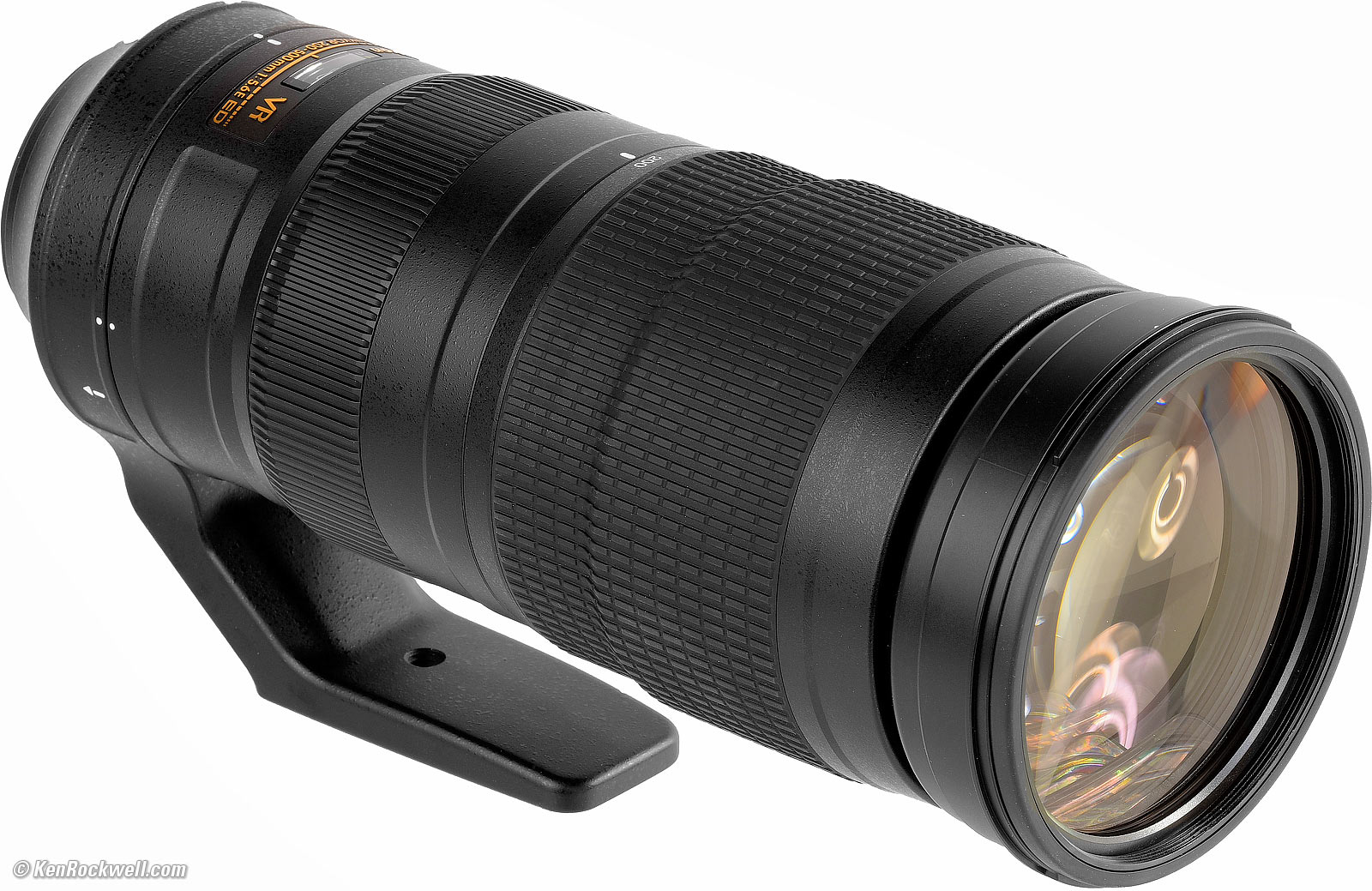
Image by Ken Rockwell
Nikon has been getting a lot of bad press lately for questionable investments (360 key mission cameras) and decisions about it's products (cancellation of DL compact cameras) as well as a total no-show at the latest CP+ camera show in Japan in early 2017, the year of their first century - not out. The interchangeable lens camera (ILS) and compact camera markets are shrinking year on year as more and more people buy smart-phones...
Pity, because at it's core there are some pretty good lens and camera designers that have given us hits like the D3 full frame in 2007, the D700 (the D3 wolf in sheep's clothing) in 2008 and lately (2014) the D810, a camera so phenomenal that two years after it's release it is still considered by many as one of the best all-round cameras out there. And that's saying a lot as since it's release both Canon and Sony have upped the mega-pixel wars and released worth adversaries.
As to lenses Nikon has also been quietly productive coming out in recent years with some ground-breaking designs such as the 14-24 f2.8 wide angle zoom lens that redefined what a zoom lens could or should do. It was so spectacular that it totaly eclipsed Nikon's own prime 14mm f2.8 lens. A zoom better than a prime you say?! Yes, I can confirm from personal experience that this was indeed the case. Since then with a few wobbles along the way (Nikon 70-200 VRII focus breathing debacle anyone) they have managed to quietly come up with some stellar lenses such as their line of f1.8 consumer lenses (20mm, 24, 28, 35) which seemed just as good as their trice more expensive f1.4 versions, or the unique 105 f1.4 portrait lens and let us not forget the insanely expensive but well received 70-200 f2.8 E lens that resolved the focus breathing issue, focuses closer and has finally got it's focus buttons back. And that lens comes with a particularly well-designed lens foot.
Glad you brought that up about the lens foot.. Because THAT seems to be an area that Nikon has not been at the top of it's engineering game if this man is to be believed. "This man" is Bjorn Rorslett and he has criticized just about every lens foot design that came out of Nikon since it's transition to AF-S motors and basically has said that they are all cow's manure. There is now a whole new industry started by people like Really Right Stuff and Kirk and Wimberly that created alternative foot supports for lenses to a) be used in Arca-swiss style clamps, the defacto standard in photography and b) to resolve the issue of less than stellar support in some cases. We'll get back to RRS in a little while. Suffice it to say that for around 20 years these manufacturers and now a slew of Chinese copycats have been improving on OEM designs and making money.
If you've reached this far into my post you may be wondering what the whole point of this history lesson has been. And you would be right in asking that. So let's now turn away from history in general and focus on my personal experience. A little over a year ago I went out and bought my very own Nikon 200-500 f5.6E lens (released in 2015). For any of you uninitiated in the world of camera lenses a 500mm lens is quite a beast, the gold standard for nature photography and pap-style shooting. Nikon had finally come out with a zoom lens that reached out this far and in a very budget-friendly price of $1395 or thereabouts. This lens intrigued many reviewers who immediately set the hoards of nature photographers out onto online retailers with the exhortatation of "Buy, buy, buy".. in the vein of Hollywood movies about Wall Street. And I dutifully obeyed.
And when my lens arrived I was astounded at a) it's size, b) it's weight and c) it's image quality. It was so good that I nearly threw my 28-300 superzoom away in disgust! (Later I traded that lens for a 20 year old 80-200 f2.8AF-D, but that as they say is another story).
However all the A + B meant that getting any decent C out of the lens meant proper support. On a tripod. A very big and stable tripod. Which fortunately I had. When used in static positions with a Wimberly sidekick gimbal mount (remember the lens plate guys I mentioned above - this is one of them) the lens worked a treat and though top heavy, especially when extended out to 500mm, it still worked ok.
Where the lens didn't work was when hand-held, or when travelling and then walking around with the lens. For example as I might do at the top of a mountain on a 3 day hike taking pictures of rare birds. Or at an airshow with planes swooping everywhere. Or out a window taking pictures of the couple across the road... Ok scratch that last one! In those situations it was a real pain in the rear end.
Why?
Well, the badly designed lens foot. Besides being a cantilevered design, shown by the gentleman I mentioned previously to be thorougly inadequate for locking down a lens to avoid vibrations, there was nowhere to support the lens when you weren't using it. You either had to sling it onto your shoulder while keeping a hand on the camera or keep it in a bag... a very BIG bag. Having it hanging from the camera straps around your neck was inviting disaster as both lens and camera mounts were likely to sag and bend from the strain.. Also because Nikon (unlike Tamron in 2017) doesn't build in the arca-swiss dovetail design into their lens feet meant I had to add a plate from, yes, you guessed it RRS from above. That plate worked fine for fixing the lens to a clamp on a tripod, but there was no-where to attach a strap on the lens itself, as Nikon's more expensive lenses have as standard. Ok, I won't moan here.. I'm getting a $1395 lens that is pretty close optically to a $6500 lens.. I can't expect the same level of finishing. Still... Nikon could have put just a little more thought into the design..
Now more than a year into the len's release Kirk, then Chinese copycat guys and finally our trusty friends from RRS have come out with some solutions. But do they solve our problems? Let's have a look. First up is the Kirk/Chinese solution, which I found first about 2 months ago on Ebay.
The Chinese ($50) is an close copy of the Kirk ($150) although the plate is not as long - They essentially remade the whole mount including lens collar and integrated an arca swiss dovetail into the foot. Up to here all is good as it resolves having a lens plate and at $50 (if you're ok with the Chinese copy, which I am) is not excessive considering you'd have to pay around 15-20$ just of the lens plate... and you eliminate the risk of the lens-plate coming loose at any time (it has happened though thankfully no disasters ensued!).
However one glaring design flaw is that they've made the cantilivered design even more fragile and prone to introduce vibration into the lens. I come to this conclusion only by looking at the images online in the ebay advert.. although this very good review in the DPREVIEW forum counters my claim... I won't belabour the point, but for me it's a case of 1 step forward and 1 step back.
Then a week ago I saw a RRS tripod colar for this lens advertised on B&H! For the modical amount of $250! Yes, RRS is not shy of their prices, but I can attest to their quality. But $250???????! Anyway, let's examine the soundness of the design. They too include an arca-swiss dovetail into the lens foot but improve on the Kirk version by setting the foot all the way back and eliminating the cantiliver aspect thereby making a support that is sure to be more stable (though testing would be required to see how stable). A nice touch is that they've recreated Nikon's own foot release (from their 70-200 line of lenses) which makes taking of the foot child's play. However in a display of truly not understanding HOW some of us photographers work out in the field, they've added a lens strap to a lug screwed into the bottom of the plate (this may not be included in the package and was in the B&H photo section for the lens).
Why is that not a good thing? For one it makes carrying the lens on a strap and using it on a tripod or monopod mutually exclusive, as you have to unscrew the lug before you can slide the foot into a clamp. The whole POINT of arca-swiss style plates and clamps is that they are fast to use! Secondly and more importantly those lugs can come unscrewed very quickly, especially if you're running along with the lens flopping along behind you.. That can spell big trouble.
So although a much more stable design when used on a tripod, the RRS basically negates it's usefulness by not having an adaquate CARRYING solution..
And the solution?
Well I present my MacGyver workaround that hopefully will inspire a lens plate manufacturer to come up with something a) economical b) that solves the cantiliver stability problem c) includes an arca swiss plate into the foot and d) includes a solid carrying connection solution built into the lens plate by placing lug mounts on either end of the lens plate that distributes the weight of the lens on two points and allows the use of comfortable carrying straps such as the Optech. Phew... I can breath now after that long sentence!


I have taken a $20 chinese clamp (great quality by the way) with dual slots for straps to be mounted, threaded through Optech quick release straps, put a plate onto the Nikon lens foot (about $10 for a chinese knock-off, or around $50 for my RRS plate) and now have a stable solution to carry the lens thus and for the modical amout of $30 (or $60).
When I want to use a monopod or tripod, I simply loosten the chinese clamp and voilá!
I'm a bit saddened that a company like RRS that supposedly only manufacture lens and camera solutions hadn't thought about the need to hand-carry a lens so obviously designed for hand-carrying. Makes me wonder what we're paying the big bucks for?! The Chinese solution is a little bit less thought out although it does solve one fundamental issue (arca-swiss clamp) and with Vibration Reduction (VR) in this lens it is debatable whether the cantiliver issue will be a problem in anything but the longest or shortest exposures.. and at the price they are truly competitive. RRS does have an elegant design with a removable foot, I do admit. But elegance is trumped by practicality, and there is not enough of it going on here.
My solution is not without it's flaws. A plate bolted onto the Nikon lens collar can become dislodged.. the lens clamp I've attached to the plate can also work it's way loose if not tied down properly. But overall and for short periods of time it makes hand-carrying this beast of a lens quite enjoyable. It's there in your hand when you need it, and you slide it back behind your shoulder when you're walking looking for an image.
So the call is to you plate manufacturers! Can you make a one-piece solution?
Monday, October 24, 2016
Ponta whale season

Just a "quick" animated gif of a whale jumping outside my window in Ponta do Ouro.. Adobe tutorials are not so easy to follow.. or rather Photoshop is a convoluted confusing mess! But still managed to string it together. Enjoy.
Oh.. forgot to mention, for the technically minded I used a Nikon D810 in 1.5x crop mode and shot at 7 frames per second. The lens used was nikon's maxi zoom, the 200-500, though I'm not sure I used an extender or not.. probably the info is buried somewhere in the exif information if I could bother to look at it.. But there it is.. as. Oh, and by the way, trying to grab a shot of a whale jumping is akin to take photos of an asteroid from a spinning space shuttle.. Not impossible, just very very hard!
Saturday, April 9, 2016
A little game reserve in Swaziland
Nope. I'm not telling you where it is. Because it's that good. Small. Welcoming. You can walk around and take pictures and see animals and hike.. and really have a wonderful wildlife experience. Unlike the Kruger where you're confined to your car, this place really lets you roam. And as long as you don't go swimming you should be out of reach of their most dangerous predators (the Crocs!).
Here are some pics of the place.


Here are some pics of the place.


Thursday, February 18, 2016
Apple woes..
At various points in my life I've made some BIG decisions. One was to propose to my now wife. The other was to have a Dog. And when we didn't kill the dog, to have children. Other BIG decisions, though lower on the Richter scale of BIG, still meant a big change that altered my routine, way of thinking, even life. One of these was the change from Canon to Nikon. It is fitting that as this blog calls itself "fotografic" I should have at least ONE big decision that is photo related.. But wait, there's more!!! Another big decison in around 2001 was from film to digital. And again in 2015, from digital to film! But probably the most important BIG decision (after my wife, the dog and kids) was moving from Windows to Apple. That was a biggie... I mean I was CIO at my contruction company for many years, growing up from a 9600k modem connection in 1994 to VSats and Lotus Notes and Cisco routers and whatnot. Windows at the time was my life, and I spent as much time tinkering with the innards of my personal laptop as much as actually using it to do things. Updates, defrags and compacts, shutdown-restarts ad infinitum, blue screens of death, format and re-instals.. The endless software updates (from windows 3.1, windows NT, 98, 2000 and .. oh.. I forget) and incompatibilities that came with every major release..
So one day after a bit of research (Apple users looked so relaxed!) I decided to make the switch. The fact that my Dell imploded due to some rather dodgy video card did help the decision along.. 1 year guarantees my foot!
So I went out and bought a shiny new iMac and the world was a wonderful new place to be in. Routines were completely irrelevant now! I could simply DO stuff on my computer (I was about to say PC... but now it's a MAC) and all that time spent upgrading and whatnot was saved..
Or so I thought. The change came in 2008. Since then I'm onto my second Mac, now a Macbook pro, a zillion times faster than the iMac, with 5 times as much ram and hard disk space.. But I seem to be spending more and more time.. upgrading.. and updating.. and cleaning (though thankfully no long defrags into the night). Apple has become just as bad as Windows ever was, and I am now spending more time under the hood than behind the wheel. Which is unfortunate because while I knew what was going on with Windows I have absolutely none when it comes to Apple. It just works.. or at least it's supposed to.
Maybe I exaggerate when I say it's as bad as Windows. I mean it's not like I have constant virus warnings or peripherals that refuse to work. Most of that goes quite well. It's in the little things that SHOULD work but don't. As this is a fotografic (sic) blog, let's talk about my photography. I have close to 60K pictures in my Lightroom library. I have an iPhone, which is purported to be the best mobile phone on the planet. And the two have decided they don't know each other anymore. It's like a relationship gone sour. And this is a problem because Apple sold me a phone which has 16gb.. except it only has 12. And that means that after they've installed their Bloatware, and I've installed all my bloatware on it, there is scarcely any space for pictures! And when I want to download them.. I CAN'T! Solution?! Well, I one involved in IT.. I can always find a work-around.. but that implies more time playing under the hood, and less time deleting the 90% crap pictures I took and concentrating on the few decent images that I made. And printing them out. And framing them. And getting all warm and gushy when people notice them and say how spectacular they are.. Yes, I know I'm dreaming, but it's what you do when you own a Mac.
So does this mean that I made the wrong decision when I forsook Win for Mac? Or Nikon for Canon? Or my dog for kids?! :-)
Of course not. It's just the realisation that big changes are not the panacea that they are made out to be, or marketed as. Certainly apple has made many things easier, but it brings it's own frustrations. And the more I bump up against the walls of the closed garden that is Apple's way of making it's products, the more I become frustrated by their arbitrary decisions on how I must use their products, as well as the momentary glitches that mar their earlier rise to popularity.
Apple has become obsessed with it's own beauty and, much like Narcissus staring at himself in the pond, it simplifies it's products to the point of no return, objects for the mere purpose of being beautiful, and not longer about satisfying our ever increasing need for personal expression, for working with our tools in ways that we want and not necessarily in the way that GOD (aka Steve) intended. Where will it all end? Where does a great company like Apple go once it's reached it's zenith? Well we're either about to colonise Mars, or they will go down. I can only hope that some humble pie will force them to turn off the reality distortion field that Steve installed and start thinking wholistically about their products, and acting proactively with their customers.
Rant over.
Subscribe to:
Posts (Atom)